extract package
The Extract Package handles the various plugins available for extracting face sets in Faceswap.
plugins.extract.base Module
Interfaces for Faceswap extract plugins
- class plugins.extract.base.ExtractPlugin(input_size: int, batch_size: int = 1, is_rgb: bool = False, dtype: str = 'float32', scale: tuple[int, int] = (0, 1), force_cpu: bool = False)
Base extract plugin that all plugins must inherit from.
- Parameters:
input_size (int) – The size of the input required by the plugin. The input will always be square at these dimensions
batch_size (int) – The batch size that the plugin processes data at. Note: Only the process method is guaranteed to receive data at this batch size (or less). The other processes may receive higher batch sizes for re-processing reasons. Do not rely on this when processing data. Default: 1
is_rgb (bool) –
Trueif the plugin expects input images to be RGB rather than BGR. Default:Falsedtype (str) – A valid datatype that the plugin expects to receive the image at. Default: “float32”
scale (tuple[int, int]) – The scale that the plugin expects to receive the image at eg: (0, 255) for uint8 images. Default: (0, 1)
force_cpu (bool) – For Torch models, force running on the CPU, rather than the accelerated device. Sets the
torch.devicetodevice. Default:False
- batch_size
The maximum batch size that this plugin’s ‘process’ method will receive
- property device: device
The selected device to run torch ops on
- dtype
The datatype that the plugin expects images at
- from_torch(batch: ndarray) ndarray
Run inference on a PyTorch model.
This function does not need to be used, however it handles torch backend for better throughput, so it is recommended. Must have used self.load_torch_model to load the Torch model to use this function.
- Parameters:
batch (ndarray) – The batch array to feed to the PyTorch model
- Return type:
The result from the PyTorch model
- input_size
The size of the plugin’s input in pixels
- is_rgb
Trueif the plugin expects RGB images.Falsefor BGR
- abstractmethod load_model() torch.nn.Module | cv2.dnn.Net | T.Any
Override to perform any model initialization code
- Return type:
The loaded model that will be accessible from
Model
- load_torch_model(model: Module, weights_path: str, return_indices: list[int] | None = None) Module
Load a PyTorch model, apply the weights and pass a warmup batch through
This function does not need to be used, but some default Faceswap optimizations are performed here, so without using this function you will either need to apply them yourself or not have them applied
- Parameters:
model (Module) – The Torch model to load
weights_path (str) – Full path to the weights file to load
return_indices (list[int] | None) – If the model outputs multiple items, but you only require some of them, the indices of the required items can be placed here so that when calling from_torch any extra data is not copied from the GPU. Default:
None(return all data)
- Return type:
The loaded model ready for inference
- model: torch.nn.Module | cv2.dnn.Net | T.Any
The loaded model for the plugin
- name
The name of the plugin. Derived from the module name
- post_process(batch: ndarray) NDArray[float32]
Override to perform post-processing
- Parameters:
batch (ndarray) – This will be the output from the previous ‘process’ step
- Returns:
For detect plugins this must be an (N, M, left, top, right, bottom) bounding boxes for
detected faces scaled to model input size as float32. N is the batch size, M is the number
of detections per batch
For align plugins this must be an (N, 68, 2) float32 array for each (x, y) landmark point
for each face in the batch. co-ordinates should be normalized to 0.0 to 1.0 range
For mask plugins this must be an (N, size, size) float32 image in range 0. - 1.0 for each
face in the batch
For identity plugins this must be an (N, M) float32 identity embedding
- Return type:
NDArray[float32]
- pre_process(batch: ndarray) ndarray
Override to perform pre-processing
- Parameters:
batch (ndarray) –
For detection plugins, this will be a batch of square, padded, images at model input size in the plugin’s color order, image format and data range.
For align plugins this will be a face detection ROI bounding box (batch size, left, top, right, bottom) as INT32.
For all other plugins this will be a batch of aligned face images at model input size in the plugin’s color order, image format and data range
- Returns:
For align plugins, this should be an adjustment of the detected face’s bounding box to cut
a square out of the original image for feeding the model. Out of bounds values are allowed,
as these will be handled. This bounding box will be used to prepare the image at the
correct size for feeding the model.
For all other plugins, any pre-processing (eg normalization) should be applied ready for
feeding the model.
- Return type:
ndarray
- abstractmethod process(batch: ndarray) ndarray
Override to perform processing. This is where the model should be called
- Parameters:
batch (ndarray) –
For detection plugins, this will be a batch of square, padded, images at model input size in the correct format for feeding the model
For align, mask and identity plugins this will be a batch of square face patches at model input size in the correct format for feeding the model
- Returns:
This can return any numpy array, but it must be a numpy array. For detect plugins that can
return several results, usually in a list, then this must be an object array
- Return type:
ndarray
- scale
The numeric range that the plugin expects images to be in
- class plugins.extract.base.FacePlugin(input_size: int, batch_size: int = 1, is_rgb: bool = False, dtype: str = 'float32', scale: tuple[int, int] = (0, 1), force_cpu: bool = False, centering: Literal['face', 'head', 'legacy'] = 'face')
Base extract plugin that all plugins that work with aligned faces must inherit from.
- Parameters:
input_size (int) – The size of the input required by the plugin. The input will always be square at these dimensions
batch_size (int) – The batch size that the plugin processes data at. Note: Only the process method is guaranteed to receive data at this batch size (or less). The other processes may receive higher batch sizes for re-processing reasons. Do not rely on this when processing data. Default: 1
is_rgb (bool) –
Trueif the plugin expects input images to be RGB rather than BGR. Default:Falsedtype (str) – A valid datatype that the plugin expects to receive the image at. Default: “float32”
scale (tuple[int, int]) – The scale that the plugin expects to receive the image at eg: (0, 255) for uint8 images. Default: (0, 1)
force_cpu (bool) – For Torch models, force running on the CPU, rather than the accelerated device. Sets the
torch.devicetodevice. Default:Falsecentering (CenteringType) – The centering that the mask should be stored at
- centering: CenteringType
The aligned centering of the image patch to feed the model
- storage_name
Dictionary safe name for storing the serialized data
- Type:
str
Classes
|
Base extract plugin that all plugins must inherit from. |
|
Base extract plugin that all plugins that work with aligned faces must inherit from. |
Class Inheritance Diagram

align package
plugins.extract.align.cv2_dnn Module
CV2 DNN landmarks extractor for faceswap.py Adapted from: https://github.com/yinguobing/cnn-facial-landmark MIT License
Copyright (c) 2017 Yin Guobing
Permission is hereby granted, free of charge, to any person obtaining a copy of this software and associated documentation files (the “Software”), to deal in the Software without restriction, including without limitation the rights to use, copy, modify, merge, publish, distribute, sublicense, and/or sell copies of the Software, and to permit persons to whom the Software is furnished to do so, subject to the following conditions:
The above copyright notice and this permission notice shall be included in all copies or substantial portions of the Software.
THE SOFTWARE IS PROVIDED “AS IS”, WITHOUT WARRANTY OF ANY KIND, EXPRESS OR IMPLIED, INCLUDING BUT NOT LIMITED TO THE WARRANTIES OF MERCHANTABILITY, FITNESS FOR A PARTICULAR PURPOSE AND NONINFRINGEMENT. IN NO EVENT SHALL THE AUTHORS OR COPYRIGHT HOLDERS BE LIABLE FOR ANY CLAIM, DAMAGES OR OTHER LIABILITY, WHETHER IN AN ACTION OF CONTRACT, TORT OR OTHERWISE, ARISING FROM, OUT OF OR IN CONNECTION WITH THE SOFTWARE OR THE USE OR OTHER DEALINGS IN THE SOFTWARE.
- class plugins.extract.align.cv2_dnn.CV2DNNAlign
CV2 DNN Plugin for face alignment
- load_model() Net
Load the CV2 DNN Aligner Model
- Return type:
The loaded cv2-DNN model
- model: cv2.dnn.Net
The loaded model for the plugin
- pre_process(batch: ndarray) ndarray
Format the ROI faces detection boxes for prediction
- Parameters:
batch (ndarray) – The batch of face detection bounding boxes as (bs, l, t, r, b)
- Return type:
The face detection bounding boxes formatted to take an image patch for prediction
- process(batch: ndarray) ndarray
Predict the 68 point landmarks
- Parameters:
feed – The batch to feed into the aligner
batch (ndarray)
- Return type:
The predictions from the aligner
Classes
CV2 DNN Plugin for face alignment |
Class Inheritance Diagram

plugins.extract.align.dark_decoder Module
DARK heatmap decoding for heatmap based aligners.
- class plugins.extract.align.dark_decoder.Dark(num_points: int, size: int, blur_kernel: int = 11)
Dark heatmap decoding
https://github.com/ilovepose/DarkPose
- Parameters:
num_points (int) – The number of landmarks output from the model
size (int) – The size of the heatmap
blur_kernel (int)
- __call__(heatmap: ndarray)
Call self as a function.
- Parameters:
heatmap (ndarray)
- gaussian_blur(heatmap: ndarray) ndarray
Perform gaussian blurring on the heatmaps
- Parameters:
heatmap (ndarray) – Batch of heatmaps to blur (N, points, size, size)
- Return type:
The blurred heatmaps
- get_max_preds(batch_heatmaps: ndarray) ndarray
get predictions from score maps
- Parameters:
heatmaps – Heatmap to derive points from ([batch_size, num_joints, height, width])
batch_heatmaps (ndarray)
- Returns:
The derived points from the heatmaps (B, N, 2)
- Return type:
coords
- taylor(heatmap: ndarray, coords: ndarray) ndarray
Sub-pixel refine the predictions
- Parameters:
heatmap (ndarray) – The processed heatmaps for refinement
coords (ndarray) – The coordinates to be refined
- Return type:
The refined coordinates
Classes
|
Dark heatmap decoding |
Variables
A standard |
Class Inheritance Diagram

plugins.extract.align.fan Module
Facial landmarks extractor for faceswap.py Code adapted and modified from: https://github.com/1adrianb/face-alignment
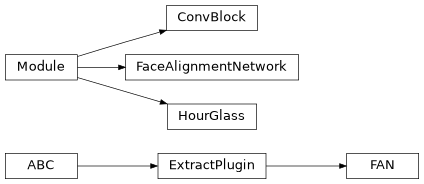
- class plugins.extract.align.fan.ConvBlock(num_in: int, num_out: int)
Convolution block for FAN
- Parameters:
num_in (int) – The number of in channels
num_out (int) – The number of out channels
- forward(inputs: Tensor) Tensor
Forward pass through FAN’s conv block
- Parameters:
inputs (Tensor) – Input to the conv block
- Return type:
Output from the conv block
- class plugins.extract.align.fan.FAN
FAN Face alignment
- load_model() FaceAlignmentNetwork
Load the FAN model
- Return type:
The loaded FAN model
- model: FaceAlignmentNetwork
The loaded model for the plugin
- post_process(batch: ndarray) ndarray
Process the output from the model
- Parameters:
batch (ndarray) – The predictions from the aligner
- Return type:
The final landmarks in 0-1 space
- pre_process(batch: ndarray) ndarray
Format the ROI faces detection boxes for prediction
- Parameters:
batch (ndarray) – The batch of face detection bounding boxes as (bs, l, t, r, b)
- Return type:
The face detection bounding boxes formatted to take an image patch for prediction
- process(batch: ndarray) ndarray
Predict the 68 point landmarks
- Parameters:
batch (ndarray) – The batch to feed into the aligner
- Return type:
The predictions from the aligner
- class plugins.extract.align.fan.FaceAlignmentNetwork(num_stack: int = 4, num_modules: int = 1, hg_depth: int = 4, num_features: int = 256, num_classes: int = 68)
2D FAN alignment for faceswap
- Parameters:
num_stack (int)
num_modules (int)
hg_depth (int)
num_features (int)
num_classes (int)
- forward(inputs: Tensor) list[Tensor]
Forward pass through FAN face alignment
- Parameters:
inputs (Tensor) – Input to FAN
- Return type:
Output from FAN
- class plugins.extract.align.fan.HourGlass(num_modules: int, depth: int, num_features: int)
Hour-glass module for FAN
- Parameters:
num_modules (int) – The number of modules in the hour-glass network
depth (int) – The depth of the hour-glass network
num_features (int) – The number of features to generate
- forward(inputs: Tensor) Tensor
Forward pass through FAN’s hour-glass network
- Parameters:
inputs (Tensor) – Input to the hour-glass network
- Return type:
Output from the hour-glass network
Classes
|
Convolution block for FAN |
|
FAN Face alignment |
|
2D FAN alignment for faceswap |
|
Hour-glass module for FAN |
Class Inheritance Diagram
plugins.extract.align.hrnet Module
Facial landmarks extractor for faceswap.pnt_y Code adapted and modified from: https://github.com/1adrianb/face-alignment
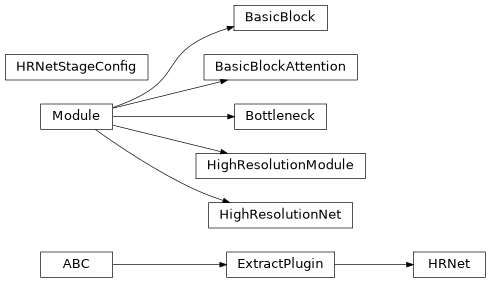
- class plugins.extract.align.hrnet.BasicBlock(in_channels: int, out_channels: int, stride: int = 1, downsample: Module | None = None)
Basic block for HRNet
- Parameters:
in_channels (int) – The number of in channels
out_channels (int) – The number of out channels
stride (int) – The stride for the first 3x3 conv block. Default: 1
downsample (nn.Module | None) – The module to use for downsampling or
Nonefor no downsample. Default:None
- forward(inputs: Tensor) Tensor
Forward pass through HRNet’s basic block
- Parameters:
inputs (Tensor) – Input to the conv block
- Return type:
Output from the conv block
- class plugins.extract.align.hrnet.BasicBlockAttention(in_channels, out_channels, stride=1, downsample=None)
Custom Basic block for HRNet with Attention
- Parameters:
in_channels – The number of in channels
out_channels – The number of out channels
stride – The stride for the first 3x3 conv block. Default: 1
downsample – The module to use for downsampling or
Nonefor no downsample. Default:None
- forward(inputs: Tensor) Tensor
Forward pass through HRNet’s basic block with attention
- Parameters:
inputs (Tensor) – Input to the conv block
- Return type:
Output from the conv block
- class plugins.extract.align.hrnet.Bottleneck(in_channels: int, out_channels: int, stride: int = 1, downsample: Module | None = None)
Bottleneck for HRNet
- Parameters:
in_channels (int) – The number of in channels
out_channels (int) – The number of out channels
stride (int) – The stride for the first 3x3 conv block. Default: 1
downsample (nn.Module | None) – The module to use for downsampling or
Nonefor no downsample. Default:None
- forward(inputs: Tensor) Tensor
Forward pass through HRNet’s basic block
- Parameters:
inputs (Tensor) – Input to the conv block
- Return type:
Output from the conv block
- class plugins.extract.align.hrnet.HRNet
HRNet Face alignment
- load_model() HighResolutionNet
Load the HRNet model
- Return type:
The loaded HRNet model
- model: HighResolutionNet
The loaded model for the plugin
- post_process(batch: ndarray) ndarray
Process the output from the model
- Parameters:
batch (ndarray) – The predictions from the aligner
- Return type:
The final landmarks in 0-1 space
- pre_process(batch: ndarray) ndarray
Format the ROI faces detection boxes for prediction
- Parameters:
batch (ndarray) – The batch of face detection bounding boxes as (bs, l, t, r, b)
- Return type:
The face detection bounding boxes formatted to take an image patch for prediction
- process(batch: ndarray) ndarray
Predict the 68 point landmarks
- Parameters:
batch (ndarray) – The batch to feed into the aligner
- Return type:
The predictions from the aligner
- class plugins.extract.align.hrnet.HRNetStageConfig(num_modules: int, num_branches: int, num_blocks: list[int], num_channels: list[int], block: Literal['ATTENTION', 'BLOCK', 'BOTTLENECK'])
Configuration settings for each stage of HRNet
- Parameters:
num_modules (int)
num_branches (int)
num_blocks (list[int])
num_channels (list[int])
block (Literal['ATTENTION', 'BLOCK', 'BOTTLENECK'])
- class plugins.extract.align.hrnet.HighResolutionModule(num_branches: int, block: type[BasicBlockAttention] | type[BasicBlock] | type[Bottleneck], num_blocks: list[int], num_in_channels: list[int], num_channels: list[int], multi_scale_output: bool = True)
High Resolution Module for HRNet
- Parameters:
num_branches (int) – The number of branches to use
blocks – The block object to use
num_blocks (list[int]) – The number of blocks in each branch
num_in_channels (list[int]) – The number of input channels in each branch
num_channels (list[int]) – The number of channels in each branch
multi_scale_output (bool) –
Trueto output multi-scaledblock (type[BasicBlockAttention] | type[BasicBlock] | type[Bottleneck])
- forward(inputs: list[Tensor]) list[Tensor]
Forward pass through the HR Module
- Parameters:
inputs (list[Tensor]) – Input to the HR Module
- Return type:
Output from the HR Module
- get_num_in_channels() list[int]
Obtain the number of input channels to the module
- Return type:
The number of input channels to the module
- class plugins.extract.align.hrnet.HighResolutionNet(num_joints: int, final_conv_kernel: int, stage_2_config: HRNetStageConfig, stage_3_config: HRNetStageConfig, stage_4_config: HRNetStageConfig)
The HRNet Landmark Detection model
- Parameters:
num_joints (int) – The number of joints in the model
final_conv_kernel (int) – Kernel size of the final convolution
stage_2_config (HRNetStageConfig) – Configuration settings for stage 2 layers
stage_3_config (HRNetStageConfig) – Configuration settings for stage 3 layers
stage_4_config (HRNetStageConfig) – Configuration settings for stage 4 layers
- forward(inputs: Tensor) Tensor
Forward pass through HRNet
- Parameters:
inputs (Tensor) – Input to HRNet
- Return type:
Output from HRNet
Classes
|
Basic block for HRNet |
|
Custom Basic block for HRNet with Attention |
|
Bottleneck for HRNet |
|
HRNet Face alignment |
|
Configuration settings for each stage of HRNet |
|
High Resolution Module for HRNet |
|
The HRNet Landmark Detection model |
Class Inheritance Diagram
detect package
plugins.extract.detect.cv2_dnn Module
OpenCV DNN Face detection plugin
- class plugins.extract.detect.cv2_dnn.CV2DNNDetect
CV2 DNN detector for face recognition
- load_model() Net
Load the CV2 DNN Detector Model
- Return type:
The loaded cv2-DNN model
- model: cv2.dnn.Net
The loaded model for the plugin
- post_process(batch: ndarray) ndarray
Compile found faces for output
- Parameters:
batch (ndarray) – The detection results for the model
- Return type:
The processed detection bounding box from the model at model input size
- pre_process(batch: ndarray) ndarray
Compile the detection image(s) for prediction
- Parameters:
batch (ndarray) – The input batch of images at model input size in the correct color order
- Return type:
The batch of images ready for feeding the model
- process(batch: ndarray) ndarray
Run model to get predictions
- Parameters:
batch (ndarray) – A batch of images ready to feed the model
- Return type:
The batch of detection results from the model
Classes
CV2 DNN detector for face recognition |
Class Inheritance Diagram

plugins.extract.detect.mtcnn Module
MTCNN Face detection plugin
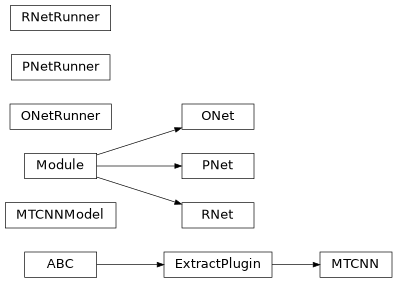
- class plugins.extract.detect.mtcnn.MTCNN
MTCNN detector for face recognition.
- load_model() MTCNNModel
Load the model
- Return type:
The loaded MTCNN model
- model: MTCNNModel
The loaded model for the plugin
- post_process(batch: ndarray) ndarray
Remove confidences from output
- Parameters:
batch (ndarray) – The detection results for the model
- Return type:
The processed detection bounding box from the model at model input size
- pre_process(batch: ndarray) ndarray
Compile the detection image(s) for prediction. No further pre-processing required for MTCNN
- Parameters:
batch (ndarray) – The input batch of images at model input size in the correct color order
- Return type:
The batch of images ready for feeding the model
- process(batch: ndarray) ndarray
Run model to get predictions
- Parameters:
batch (ndarray) – A batch of images ready to feed the model
- Return type:
The batch of detection results from the model
- class plugins.extract.detect.mtcnn.MTCNNModel(weights_path: list[str], device: device, input_size: int = 640, min_size: int = 20, threshold: list[float] | None = None, factor: float = 0.709)
MTCNN Detector for face alignment
- Parameters:
weights_path (list[str]) – List of paths to the 3 MTCNN subnet weights
device (torch.device) – The device to run inference on
input_size (int) – The height, width input size to the model. Default: 640
min_size (int) – The minimum size of a face to accept as a detection. Default: 20
threshold (list[float] | None) – List of floats for the three steps, Default: [0.6, 0.7, 0.7]
factor (float) – The factor used to create a scaling pyramid of face sizes to detect in the image. Default: 0.709
- detect_faces(batch: ndarray) tuple[ndarray, tuple[ndarray]]
Detects faces in an image, and returns bounding boxes and points for them.
- Parameters:
batch (ndarray) – The input batch of images to detect face in
- Return type:
List of numpy arrays containing the bounding box and 5 point landmarks of detected faces
- class plugins.extract.detect.mtcnn.ONet(weights_path: str)
PyTorch O-Net model Definition for MTCNN
- Parameters:
weights_path (str) – The path to the torch weights file
- forward(inputs: Tensor) tuple[Tensor, Tensor, Tensor]
Keras O-Network Definition for MTCNN
- Parameters:
inputs (Tensor) – The input to ONet
- Returns:
classifier – The result from ONet classifier
bbox_regress – The result from ONet bbox regression
landmark_regress – The result from ONet landmark regression
- Return type:
tuple[Tensor, Tensor, Tensor]
- class plugins.extract.detect.mtcnn.ONetRunner(weights_path: str, device: device, input_size: int, threshold: float)
Keras O-Net model for MTCNN
- Parameters:
weights_path (str) – The path to the torch model file
device (torch.device) – The device to run inference on
input_size (int) – The input size of the model
threshold (float) – Threshold for O-Net
- __call__(images: ndarray, rectangle_batch: list[ndarray]) list[tuple[ndarray, ndarray]]
Third stage - further refinement and facial landmarks positions with o-net
- Parameters:
images (ndarray) – The batch of images to detect faces in
rectangle_batch (list[ndarray]) – List of
numpy.ndarrayface candidates from R-Net
- Return type:
List of refined final candidates, scores and landmark points from O-Net
- class plugins.extract.detect.mtcnn.PNet(weights_path: str)
PyTorch P-Net model for MTCNN
- Parameters:
weights_path (str) – The path to the torch model file
- forward(inputs: Tensor) tuple[Tensor, Tensor]
PyTorch P-Network Definition for MTCNN
- Parameters:
inputs (Tensor) – The input tensor to PNet
- Returns:
classifier – The result from PNet classifier
bbox_regress – The result from PNet bbox regression
- Return type:
tuple[Tensor, Tensor]
- class plugins.extract.detect.mtcnn.PNetRunner(weights_path: str, device: device, input_size: int, min_size: int, factor: float, threshold: float)
Runner for PyTorch P-Net model for MTCNN
- Parameters:
weights_path (str) – The path to the torch model file
device (torch.device) – The device to use for model inference
input_size (int) – The input size of the model
min_size (int) – The minimum size of a face to accept as a detection. Default: 20
threshold (float) – Threshold for P-Net
factor (float)
- __call__(images: ndarray) list[ndarray]
first stage - fast proposal network (p-net) to obtain face candidates
- Parameters:
images (ndarray) – The batch of images to detect faces in
- Return type:
List of face candidates from P-Net
- class plugins.extract.detect.mtcnn.RNet(weights_path: str)
PyTorch R-Net model Definition for MTCNN
- Parameters:
weights_path (str) – The path to the torch weights file
- forward(inputs: Tensor) tuple[Tensor, Tensor]
Keras R-Network Definition for MTCNN
- Parameters:
inputs (Tensor) – The input to RNet
- Returns:
classifier – The result from RNet classifier
bbox_regress – The result from RNet bbox regression
- Return type:
tuple[Tensor, Tensor]
- class plugins.extract.detect.mtcnn.RNetRunner(weights_path: str, device: device, input_size: int, threshold: float)
Runner for PyTorch R-Net for MTCNN
- Parameters:
weights_path (str) – The path to the torch model file
device (torch.device) – The device to run inference on
input_size (int) – The input size of the model
threshold (float) – Threshold for R-Net
- __call__(images: ndarray, rectangle_batch: list[ndarray]) list[ndarray]
second stage - refinement of face candidates with r-net
- Parameters:
images (ndarray) – The batch of images to detect faces in
rectangle_batch (list[ndarray]) – face candidates from P-Net
- Return type:
Refined face candidates from R-Net
- plugins.extract.detect.mtcnn.nms(rectangles: ndarray, scores: ndarray, threshold: float, method: str = 'iom') tuple[ndarray, ndarray]
Apply non-maximum suppression on ROIs in same scale(matrix version)
- Parameters:
rectangles (ndarray) – The [b, l, t, r, b] bounding box detection candidates
threshold (float) – Threshold for successful match
method (str) – “iom” method or default. default: “iom”
scores (ndarray)
- Returns:
rectangles – The [b, l, t, r, b] bounding boxes
scores – The associated scores for the rectangles
- Return type:
tuple[ndarray, ndarray]
- plugins.extract.detect.mtcnn.rect2square(rectangles: ndarray) ndarray
change rectangles into squares (matrix version)
- Parameters:
rectangles (ndarray) – [b, x, y, x1, y1] rectangles
- Return type:
Original rectangle changed to a square
Functions
|
Apply non-maximum suppression on ROIs in same scale(matrix version) |
|
change rectangles into squares (matrix version) |
Classes
|
MTCNN detector for face recognition. |
|
MTCNN Detector for face alignment |
|
PyTorch O-Net model Definition for MTCNN |
|
Keras O-Net model for MTCNN |
|
PyTorch P-Net model for MTCNN |
|
Runner for PyTorch P-Net model for MTCNN |
|
PyTorch R-Net model Definition for MTCNN |
|
Runner for PyTorch R-Net for MTCNN |
Class Inheritance Diagram
plugins.extract.detect.retinaface Module
Retina face detector adapted from: https://github.com/biubug6/Pytorch_Retinaface
MIT License
Copyright (c) 2019 Sefik Ilkin Serengil
Permission is hereby granted, free of charge, to any person obtaining a copy of this software and associated documentation files (the “Software”), to deal in the Software without restriction, including without limitation the rights to use, copy, modify, merge, publish, distribute, sublicense, and/or sell copies of the Software, and to permit persons to whom the Software is furnished to do so, subject to the following conditions:
The above copyright notice and this permission notice shall be included in all copies or substantial portions of the Software.
THE SOFTWARE IS PROVIDED “AS IS”, WITHOUT WARRANTY OF ANY KIND, EXPRESS OR IMPLIED, INCLUDING BUT NOT LIMITED TO THE WARRANTIES OF MERCHANTABILITY, FITNESS FOR A PARTICULAR PURPOSE AND NONINFRINGEMENT. IN NO EVENT SHALL THE AUTHORS OR COPYRIGHT HOLDERS BE LIABLE FOR ANY CLAIM, DAMAGES OR OTHER LIABILITY, WHETHER IN AN ACTION OF CONTRACT, TORT OR OTHERWISE, ARISING FROM, OUT OF OR IN CONNECTION WITH THE SOFTWARE OR THE USE OR OTHER DEALINGS IN THE SOFTWARE.
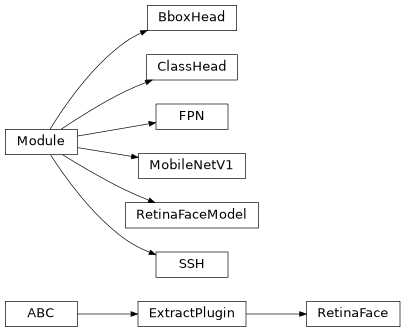
- class plugins.extract.detect.retinaface.BboxHead(in_channels: int = 512, num_anchors: int = 3)
Bounding Box Head Module for RetinaFace
- Parameters:
in_channels (int) – The number of input channels. Default: 512
num_anchors (int) – The number of anchors. Default: 3
- forward(inputs: Tensor) Tensor
Forward pass through BboxHead Module
- Parameters:
inputs (Tensor) – The input to the BboxHead Module
- Return type:
The output from BboxHead Module
- class plugins.extract.detect.retinaface.ClassHead(in_channels: int = 512, num_anchors: int = 3)
Class Head Module for RetinaFace
- Parameters:
in_channels (int) – The number of input channels. Default: 512
num_anchors (int) – The number of anchors. Default: 3
- forward(inputs: Tensor) Tensor
Forward pass through ClassHead Module
- Parameters:
inputs (Tensor) – The input to the ClassHead Module
- Return type:
The output from ClassHead Module
- class plugins.extract.detect.retinaface.FPN(in_channels_list: list[int], out_channels: int)
FPN Module for RetinaFace
- Parameters:
in_channels_list (list[int]) – The number of input channels
out_channels (int) – The number of output channels
- forward(inputs: Tensor) list[Tensor]
Forward pass through FPN Module
- Parameters:
inputs (Tensor) – The input to the FPN Module
- Return type:
The output from FPN Module
- class plugins.extract.detect.retinaface.MobileNetV1
MobileNet V1 for use with RetinaFace
- forward(inputs: Tensor) Tensor
Forward pass through MobileNetV1
- Parameters:
inputs (Tensor) – The input to MobileNetV1
- Return type:
The output from MobileNetV1
- class plugins.extract.detect.retinaface.RetinaFace
RetinaFace detector for face detection
- load_model() RetinaFaceModel
Initialize RetinaFace Model
- Return type:
The loaded RetinaFace model
- model: RetinaFaceModel
The loaded model for the plugin
- post_process(batch: ndarray) ndarray
Process the output from the model to bounding boxes
- Parameters:
batch (ndarray) – The output predictions from the S3FD model
- Return type:
The processed detection bounding box from the model at model input size
- pre_process(batch: ndarray) ndarray
Compile the detection image(s) for prediction
- Parameters:
batch (ndarray) – The input batch of images at model input size in the correct color order, dtype and scale
- Return type:
The batch of images ready for feeding the model
- process(batch: ndarray) ndarray
Run model to get predictions
- Parameters:
batch (ndarray) – A batch of images ready to feed the model
- Return type:
The batch of detection results from the model
- class plugins.extract.detect.retinaface.RetinaFaceModel(backbone: Literal['mobilenet', 'resnet'])
RetinaFace Model
- Parameters:
backbone (T.Literal['mobilenet', 'resnet']) – The backbone to use for RetinaFace
- forward(inputs: Tensor) tuple[Tensor, Tensor]
Forward pass through RetinaFace
- Parameters:
inputs (Tensor) – The input to the RetinaFace Module
- Return type:
The output from RetinaFace Module
- class plugins.extract.detect.retinaface.SSH(in_channels: int, out_channel: int)
SSH Module for RetinaFace
- Parameters:
in_channels (int) – The number of input channels
out_channels – The number of output channels
out_channel (int)
- forward(inputs: Tensor) Tensor
Forward pass through SSH Module
- Parameters:
inputs (Tensor) – The input to the SSH Module
- Return type:
The output from SSH Module
- plugins.extract.detect.retinaface.conv_bn(in_channels: int, out_channels: int, kernel: int = 3, stride: int = 1, padding: int = 1, use_relu: bool = False, leaky: float = 0.0) Sequential
Generates a Conv Batch Norm sequential module for RetinaFace
- Parameters:
in_channels (int) – The number of input channels
out_channels (int) – The number of output channels
kernel (int) – The kernel size. Default: 3
stride (int) – The number of strides. Default: 1
padding (int) – The padding to apply. Default: 1
use_relu (bool) –
Trueto use LeakyReLU activationleaky (float) – The negative float value for the LeakyReLU. Default: 0.0
- Return type:
The built sequential module
- plugins.extract.detect.retinaface.conv_dw(in_channels: int, out_channels: int, stride: int, leaky=0.1) Sequential
Generates a double Conv Batch Norm sequential module for RetinaFace
- Parameters:
in_channels (int) – The number of input channels
out_channels (int) – The number of output channels
stride (int) – The number of strides. Default: 1
leaky – The negative float value for the LeakyReLU. Default: 0.0
- Return type:
The built sequential module
Functions
|
Generates a Conv Batch Norm sequential module for RetinaFace |
|
Generates a double Conv Batch Norm sequential module for RetinaFace |
Classes
|
Bounding Box Head Module for RetinaFace |
|
Class Head Module for RetinaFace |
|
FPN Module for RetinaFace |
MobileNet V1 for use with RetinaFace |
|
RetinaFace detector for face detection |
|
|
RetinaFace Model |
|
SSH Module for RetinaFace |
Class Inheritance Diagram
plugins.extract.detect.s3fd Module
S3FD Face detection plugin https://arxiv.org/abs/1708.05237
Adapted from S3FD Port in FAN: https://github.com/1adrianb/face-alignment
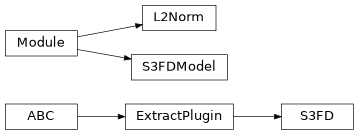
- class plugins.extract.detect.s3fd.L2Norm(n_channels: int, scale: float)
L2 Normalization layer for S3FD.
- Parameters:
n_channels (int) – The number of channels to normalize
scale (float) – The scaling for initial weights. Default: 1.0
- forward(inputs: Tensor)
Call the L2 Normalization Layer.
- Parameters:
inputs (Tensor) – The input to the L2 Normalization Layer
- Return type:
The output from the L2 Normalization Layer
- class plugins.extract.detect.s3fd.S3FD
S3FD detector for face detection
- static decode(location: ndarray, priors: ndarray) ndarray
Decode locations from predictions using priors to undo the encoding we did for offset regression at train time.
- Parameters:
location (ndarray) – location predictions for location layers,
priors (ndarray) – Prior boxes in center-offset form.
- Return type:
Decoded bounding box predictions
- post_process(batch: ndarray) ndarray
Process the output from the model to bounding boxes
- Parameters:
batch (ndarray) – The output predictions from the S3FD model
- Return type:
The processed detection bounding box from the model at model input size
- pre_process(batch: ndarray) ndarray
Compile the detection image(s) for prediction
- Parameters:
batch (ndarray) – The input batch of images at model input size in the correct color order, dtype and scale
- Return type:
The batch of images ready for feeding the model
- process(batch: ndarray) ndarray
Run model to get predictions
- Parameters:
batch (ndarray) – A batch of images ready to feed the model
- Return type:
The batch of detection results from the model
- class plugins.extract.detect.s3fd.S3FDModel
The S3FD Model, adapted from https://github.com/1adrianb/face-alignment
- forward(inputs: Tensor) list[Tensor]
Run the forward pass through S3FD
- Parameters:
inputs (Tensor) – The (N, C, H, W) batch of images to process
- Return type:
The predictions from the S3FD model
Classes
|
L2 Normalization layer for S3FD. |
|
S3FD detector for face detection |
The S3FD Model, adapted from https://github.com/1adrianb/face-alignment |
Class Inheritance Diagram
mask package
plugins.extract.mask.bisenet_fp Module
BiSeNet Face-Parsing mask plugin
Architecture and Pre-Trained Model ported from PyTorch to Keras by TorzDF from https://github.com/zllrunning/face-parsing.PyTorch
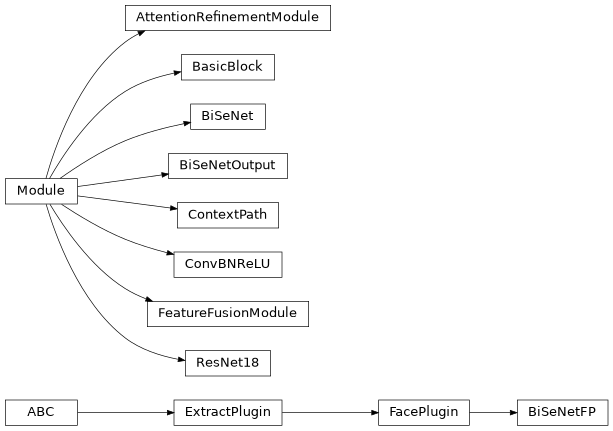
- class plugins.extract.mask.bisenet_fp.AttentionRefinementModule(in_channels: int, filters: int)
The Attention Refinement block for BiSeNet Face Parsing
- Parameters:
in_channels (int) – The number of input channels to the block
filters (int) – The dimensionality of the output space (i.e. the number of output filters in the convolution).
- forward(inputs: Tensor) Tensor
Call the Attention Refinement block.
- Parameters:
inputs (Tensor) – The input to the block
- Return type:
The output from the block
- class plugins.extract.mask.bisenet_fp.BasicBlock(in_channels: int, filters: int, stride: int = 1)
The basic building block for ResNet 18.
- Parameters:
in_channels (int) – The number of input channels
filters (int) – The dimensionality of the output space (i.e. the number of output filters in the convolution).
stride (int) – The strides of the convolution along the height and width. Default: 1
- forward(inputs: Tensor) Tensor
Call the ResNet 18 basic block.
- Parameters:
inputs (Tensor) – The input to the block
- Return type:
The output from the block
- class plugins.extract.mask.bisenet_fp.BiSeNet(num_classes: int)
BiSeNet Face-Parsing Mask from https://github.com/zllrunning/face-parsing.PyTorch
PyTorch model implemented in Keras and then back to pytorch by TorzDF, because why not?
- Parameters:
num_classes (int) – The number of segmentation classes to create
- forward(inputs: Tensor) tuple[Tensor, Tensor, Tensor]
Get predictions from the BiSeNet-FP model
- Parameters:
inputs (Tensor) – The input to BiSeNet-FP
- Return type:
The outputs from BiSeNet-FP
- class plugins.extract.mask.bisenet_fp.BiSeNetFP
Neural network to process face image into a segmentation mask of the face
- load_model() BiSeNet
Initialize the BiSeNet Face Parsing model.
- Return type:
The loaded BiSeNetFP model
- post_process(batch: ndarray) ndarray
Process the output from the model
- Parameters:
batch (ndarray) – The predictions from the masker
- Return type:
The final masks
- pre_process(batch: ndarray) ndarray
Format the detected faces for prediction
- Parameters:
batch (ndarray) – The batch of aligned faces in the correct format for the model
- Return type:
The updated images for feeding the model
- process(batch: ndarray) ndarray
Get the masks from the model
- Parameters:
batch (ndarray) – The batch to feed into the masker
- Return type:
The predicted masks from the plugin
- class plugins.extract.mask.bisenet_fp.BiSeNetOutput(in_channels: int, filters: int, num_classes: int)
The BiSeNet Output block for Face Parsing
- Parameters:
in_channels (int) – The number of input channels
filters (int) – The dimensionality of the output space (i.e. the number of output filters in the convolution).
num_class – The number of classes to generate
num_classes (int)
- forward(inputs: Tensor) Tensor
Call the BiSeNet Output block.
- Parameters:
inputs (Tensor) – The input to the block
- Return type:
The output from the block
- class plugins.extract.mask.bisenet_fp.ContextPath
The Context Path block for BiSeNet Face Parsing.
- forward(inputs: Tensor) tuple[Tensor, Tensor, Tensor]
Call the Context Path block.
- Parameters:
inputs (Tensor) – The input to the block
- Return type:
The feature outputs from ResNet 18
- class plugins.extract.mask.bisenet_fp.ConvBNReLU(in_channels: int, filters: int, kernel_size: int = 3, strides: int = 1, padding: int = 1)
Convolutional 3D with Batch Normalization block.
- Parameters:
in_channels (int) – The number of input channels
filters (int) – The dimensionality of the output space (i.e. the number of output filters in the convolution).
kernel_size (int) – The height and width of the 2D convolution window. Default: 3
strides (int) – The strides of the convolution along the height and width. Default: 1
padding (int) – The amount of padding to apply prior to the first Convolutional Layer. Default: 1
- forward(inputs: Tensor) Tensor
Call the Convolutional Batch Normalization block.
- Parameters:
inputs (Tensor) – The input to the block
- Return type:
The output from the block
- class plugins.extract.mask.bisenet_fp.FeatureFusionModule(in_channels: int, filters: int)
The Feature Fusion block for BiSeNet Face Parsing
- Parameters:
in_channels (int) – The number of input channels to the module
filters (int) – The dimensionality of the output space (i.e. the number of output filters in the convolution).
- forward(feat_spatial: Tensor, feat_context: Tensor) Tensor
Call the Feature Fusion block.
- Parameters:
feat_spatial (Tensor) – The spatial features input to the block
feat_context (Tensor) – The context features input to the block
- Return type:
The output from the block
- class plugins.extract.mask.bisenet_fp.ResNet18
ResNet 18 block. Used at the start of BiSeNet Face Parsing.
- forward(inputs: Tensor) tuple[Tensor, Tensor, Tensor]
Call the ResNet 18 block.
- Parameters:
inputs (Tensor) – The input to the ResNet 18
- Return type:
The feature outputs from ResNet 18
Classes
|
The Attention Refinement block for BiSeNet Face Parsing |
|
The basic building block for ResNet 18. |
|
BiSeNet Face-Parsing Mask from https://github.com/zllrunning/face-parsing.PyTorch |
Neural network to process face image into a segmentation mask of the face |
|
|
The BiSeNet Output block for Face Parsing |
The Context Path block for BiSeNet Face Parsing. |
|
|
Convolutional 3D with Batch Normalization block. |
|
The Feature Fusion block for BiSeNet Face Parsing |
|
ResNet 18 block. |
Class Inheritance Diagram
plugins.extract.mask.custom Module
Custom Mask for faceswap.py
- class plugins.extract.mask.custom.Custom
A mask that fills the whole face area with 1s or 0s (depending on user selected settings) for custom editing.
- load_model() None
No model to load, just return
- Return type:
None
- pre_process(batch: ndarray) ndarray
Return a zero array of the same shape and dtype as the input array
- Parameters:
batch (ndarray) – The batch of aligned faces in the correct format for the model
- Return type:
A zero’d array of the same shape and dtype as the input
- process(batch: ndarray) ndarray
Get the masks from the model
- Parameters:
batch (ndarray) – The batch to process
- Return type:
The processed empty masks
Classes
|
A mask that fills the whole face area with 1s or 0s (depending on user selected settings) for custom editing. |
Class Inheritance Diagram

plugins.extract.mask.unet_dfl Module
UNET DFL face mask plugin
Architecture and Pre-Trained Model based on… TernausNet: U-Net with VGG11 Encoder Pre-Trained on ImageNet for Image Segmentation https://arxiv.org/abs/1801.05746 https://github.com/ternaus/TernausNet
Source Implementation and fine-tune training…. https://github.com/iperov/DeepFaceLab/blob/master/nnlib/TernausNet.py
Model file sourced from… https://github.com/iperov/DeepFaceLab/blob/master/nnlib/FANSeg_256_full_face.h5
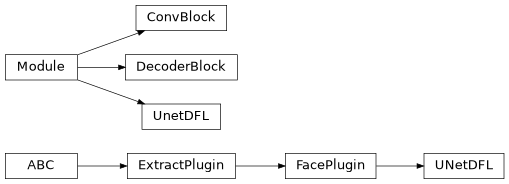
- class plugins.extract.mask.unet_dfl.ConvBlock(in_channels: int, filters: int, recursions: int)
Convolution block for UnetDFL down-scales
- Parameters:
in_channels (int) – The number of input channels to the block
filters (int) – The number of filters for the convolution
recursions (int) – The number of convolutions to run
- forward(inputs: Tensor) Tensor
Convolution Block forward pass
- Parameters:
inputs (Tensor) – The input to the convolution block
- Return type:
The output from the convolution block
- class plugins.extract.mask.unet_dfl.DecoderBlock(in_channels: int, middle_channels: int, out_channels: int, relu: bool)
Decoder Block for UnetDFL
- Parameters:
in_channels (int) – The number of input channels to the block
middle_channels (int) – The number of filters for the first convolution
out_channels (int) – The number of filters for the second convolution
relu (bool) –
Trueto use ReLU activation on the first conv.Falseto use no activation
- forward(inputs: Tensor) Tensor
Decoder block forward pass
- Parameters:
inputs (Tensor) – The input to the decoder block
- Return type:
The output from the decoder block
- class plugins.extract.mask.unet_dfl.UNetDFL
Neural network to process face image into a segmentation mask of the face
- process(batch: ndarray) ndarray
Get the masks from the model
- Parameters:
batch (ndarray) – The batch to feed into the masker
- Return type:
The predicted masks from the plugin
- class plugins.extract.mask.unet_dfl.UnetDFL
UNet DFL Definition for PyTorch
- forward(inputs: Tensor) Tensor
UnetDFL forward pass
- Parameters:
inputs (Tensor) – The input to UnetDFL
- Return type:
The output from UnetDFL
Classes
|
Convolution block for UnetDFL down-scales |
|
Decoder Block for UnetDFL |
|
Neural network to process face image into a segmentation mask of the face |
|
UNet DFL Definition for PyTorch |
Class Inheritance Diagram
plugins.extract.mask.vgg_clear Module
VGG Clear face mask plugin.
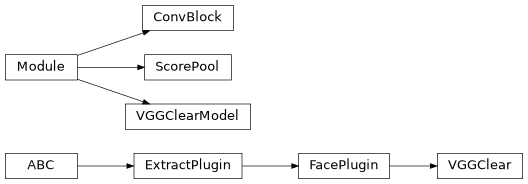
- class plugins.extract.mask.vgg_clear.ConvBlock(in_channels: int, filters: int, iterations: int, padding: int = 1)
Convolutional loop with max pooling layer for VGG Clear.
- Parameters:
in_channels (int) – The number of input channels to the model
filters (int) – The number of filters that should appear in each Conv2D layer
iterations (int) – The number of consecutive Conv2D layers to create
padding (int) – The amount of padding to apply to the first convolution
- forward(inputs: Tensor) Tensor
Call the convolutional loop.
- Parameters:
inputs (Tensor) – The input tensor to the block
- Return type:
The output tensor from the convolutional block
- class plugins.extract.mask.vgg_clear.ScorePool(in_channels: int, scale: float, crop: tuple[int, int])
Cropped scaling of the pooling layer.
- Parameters:
in_channels (int) – The number of input channels to the model
scale (float) – The scaling to apply to the pool
crop (tuple[int, int]) – The amount of 2D cropping to apply. Tuple of (Left/Top, Right/Bottom) ints
- forward(inputs: Tensor) Tensor
Call the score pool layer.
- Parameters:
inputs (Tensor) – The input tensor to the block
- Return type:
The output tensor from the block
- class plugins.extract.mask.vgg_clear.VGGClear
Neural network to process face image into a segmentation mask of the face
- load_model() VGGClearModel
Initialize the VGG Clear Mask model.
- Return type:
The loaded VGGClear model
- model: VGGClearModel
The loaded model for the plugin
- pre_process(batch: ndarray) ndarray
Format the detected faces for prediction
- Parameters:
batch (ndarray) – The batch of aligned faces in the correct format for the model
- Return type:
The updated images for feeding the model
- process(batch: ndarray) ndarray
Get the masks from the model
- Parameters:
batch (ndarray) – The batch to feed into the masker
- Return type:
The predicted masks from the plugin
- class plugins.extract.mask.vgg_clear.VGGClearModel
VGG Clear mask for Faceswap.
Caffe model re-implemented in Keras by Kyle Vrooman. Re-implemented for torch by TorzDF
References
On Face Segmentation, Face Swapping, and Face Perception (https://arxiv.org/abs/1704.06729)
Source Implementation: https://github.com/YuvalNirkin/face_segmentation
Model file sourced from: https://github.com/YuvalNirkin/face_segmentation/releases/download/1.1/face_seg_fcn8s_300_no_aug.zip
- forward(inputs: Tensor) Tensor
Call the VGG Clear Model.
- Parameters:
inputs (Tensor) – The input to the model
- Return type:
The output from the VGG-Clear model
Classes
|
Convolutional loop with max pooling layer for VGG Clear. |
|
Cropped scaling of the pooling layer. |
|
Neural network to process face image into a segmentation mask of the face |
VGG Clear mask for Faceswap. |
Class Inheritance Diagram
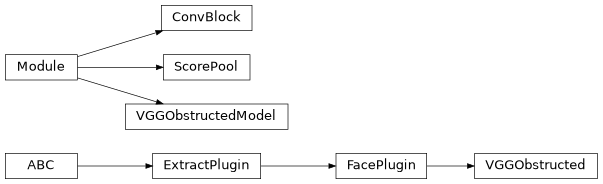
plugins.extract.mask.vgg_obstructed Module
VGG Obstructed face mask plugin
- class plugins.extract.mask.vgg_obstructed.ConvBlock(in_channels: int, filters: int, iterations: int, padding: int = 1, pool_padding: int = 1)
Convolutional loop with max pooling layer for VGG Obstructed.
- Parameters:
in_channels (int) – The number of input channels to the model
filters (int) – The number of filters that should appear in each Conv2D layer
iterations (int) – The number of consecutive Conv2D layers to create
padding (int) – The amount of padding to apply to the first convolution. Default: 1
pool_padding (int) – The amount of padding to apply to the max pooling layer. Default: 1
- forward(inputs: Tensor) Tensor
Call the convolutional loop.
- Parameters:
inputs (Tensor) – The input tensor to the block
- Return type:
The output tensor from the convolutional block
- class plugins.extract.mask.vgg_obstructed.ScorePool(in_channels: int, scale: float, crop: tuple[int, int])
Cropped scaling of the pooling layer.
- Parameters:
in_channels (int) – The number of input channels to the model
scale (float) – The scaling to apply to the pool
crop (tuple[int, int]) – The amount of 2D cropping to apply. Tuple of (Left/Top, Right/Bottom) ints
- forward(inputs: Tensor) Tensor
Call the score pool layer.
- Parameters:
inputs (Tensor) – The input tensor to the block
- Return type:
The output tensor from the block
- class plugins.extract.mask.vgg_obstructed.VGGObstructed
Neural network to process face image into a segmentation mask of the face
- load_model() VGGObstructedModel
Initialize the VGGObstructed Mask model.
- Return type:
The loaded VGGObstructed model
- model: VGGObstructedModel
The loaded model for the plugin
- pre_process(batch: ndarray) ndarray
Format the detected faces for prediction
- Parameters:
batch (ndarray) – The batch of aligned faces in the correct format for the model
- Return type:
The updated images for feeding the model
- process(batch: ndarray) ndarray
Get the masks from the model
- Parameters:
batch (ndarray) – The batch to feed into the masker
- Return type:
The predicted masks from the plugin
- class plugins.extract.mask.vgg_obstructed.VGGObstructedModel
VGG Obstructed mask for Faceswap.
Caffe model re-implemented in Keras by Kyle Vrooman. Re-implemented for Pytorch by TorzDF
References
On Face Segmentation, Face Swapping, and Face Perception (https://arxiv.org/abs/1704.06729) Source Implementation: https://github.com/YuvalNirkin/face_segmentation Model file sourced from: https://github.com/YuvalNirkin/face_segmentation/releases/download/1.0/face_seg_fcn8s.zip
- forward(inputs: Tensor) Tensor
Call the VGG Obstructed Model.
- Parameters:
inputs (Tensor) – The input to the model
- Return type:
The output from the VGG Obstructed model
Classes
|
Convolutional loop with max pooling layer for VGG Obstructed. |
|
Cropped scaling of the pooling layer. |
Neural network to process face image into a segmentation mask of the face |
|
VGG Obstructed mask for Faceswap. |
Class Inheritance Diagram
identity package
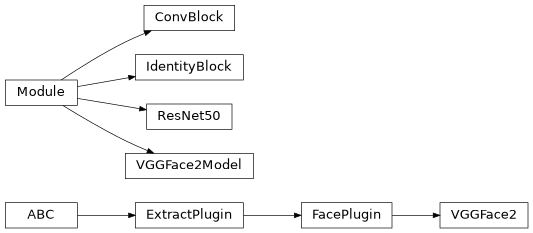
plugins.extract.identity.vggface2 Module
VGGFace inference
- class plugins.extract.identity.vggface2.ConvBlock(in_channels: int, filters: int, kernel: int, stride: int = 2)
Convolution block for ResNet50
- Parameters:
in_channels (int) – The number of input channels
filters (int) – The filters for the 1st and 2nd conv layers in the main path
kernel (int) – The kernel size of middle conv layer of the block
stride (int) – The stride length for the first and last convolution
- forward(inputs: Tensor) Tensor
Call the resnet50 ConvBlock
- Parameters:
inputs (Tensor) – Input tensor
- Return type:
Output tensor from the ConvBlock
- class plugins.extract.identity.vggface2.IdentityBlock(in_channels: int, filters: int, kernel: int)
Identity block for ResNet50
- Parameters:
in_channels (int) – The number of input channels
filters (int) – The filters for the 1st and 2nd conv layers in the main path
kernel (int) – The kernel size of middle conv layer of the block
- forward(inputs: Tensor) Tensor
Call the resnet50 Identity block
- Parameters:
inputs (Tensor) – Input tensor
- Return type:
Output tensor from the Identity block
- class plugins.extract.identity.vggface2.ResNet50
ResNet50 imported for VGG-Face2 adapted from https://github.com/WeidiXie/Keras-VGGFace2-ResNet50
- forward(inputs: Tensor) Tensor
Call the resnet50 Network
- Parameters:
inputs (Tensor) – Input tensor
- Return type:
Output tensor from resnet50
- class plugins.extract.identity.vggface2.VGGFace2
VGGFace2 feature extraction.
Extracts feature vectors from faces in order to compare similarity.
Notes
Input images should be in BGR Order
Model exported from: https://github.com/WeidiXie/Keras-VGGFace2-ResNet50 which is based on: https://www.robots.ox.ac.uk/~vgg/software/vgg_face/
Licensed under Creative Commons Attribution License. https://creativecommons.org/licenses/by-nc/4.0/
- load_model() VGGFace2Model
Initialize VGG Face 2 Model.
- Return type:
The loaded VGGFace2 model
- model: VGGFace2Model
The loaded model for the plugin
- pre_process(batch: ndarray) ndarray
Format the detected faces for prediction
- Parameters:
batch (ndarray) – The batch of aligned faces in the correct format for the model
- Return type:
The updated images for feeding the model
- process(batch: ndarray) ndarray
Get the identity matrix from the model
- Parameters:
batch (ndarray) – The batch to feed into the recognition plugin
- Return type:
The predictions from the plugin
- class plugins.extract.identity.vggface2.VGGFace2Model
VGG-Face 2 model with resnet 50 backbone. Adapted from https://github.com/WeidiXie/Keras-VGGFace2-ResNet50
- forward(inputs: Tensor) Tensor
Forward pass through the VGGFace2 model
- Parameters:
inputs (Tensor) – Input to the VGGFace2 Model
- Return type:
Output from the VGGFace2 Model
Classes
|
Convolution block for ResNet50 |
|
Identity block for ResNet50 |
|
ResNet50 imported for VGG-Face2 adapted from https://github.com/WeidiXie/Keras-VGGFace2-ResNet50 |
|
VGGFace2 feature extraction. |
VGG-Face 2 model with resnet 50 backbone. |
Class Inheritance Diagram
plugins.extract.identity.t_face Module
Tencent TFace inference
- class plugins.extract.identity.t_face.TFace
Tencent TFace with the IR 50 and IR 101 backbones
Extracts feature vectors from faces in order to compare similarity.
From: https://github.com/Tencent/TFace
- pre_process(batch: ndarray) ndarray
Format the detected faces for prediction
- Parameters:
batch (ndarray) – The batch of aligned faces in the correct format for the model
- Return type:
The updated images for feeding the model
- process(batch: ndarray) ndarray
Get the identity matrix from the model
- Parameters:
batch (ndarray) – The batch to feed into the recognition plugin
- Return type:
The predictions from the plugin
Classes
|
Tencent TFace with the IR 50 and IR 101 backbones |
Class Inheritance Diagram

extract package
plugins.extract.extract_config Module
Default configurations for extract
- plugins.extract.extract_config.load_config(config_file: str | None = None) _Config
Load the Extraction configuration .ini file
- Parameters:
Default (Path to a custom .ini configuration file to load.)
file)
config_file (str | None)
- Return type:
The loaded convert config object
Functions
|
Load the Extraction configuration .ini file |
Variables
A dataclass for storing config items loaded from config.ini files and dynamically assigning and validating that the correct datatype is used. |
|
A dataclass for storing config items loaded from config.ini files and dynamically assigning and validating that the correct datatype is used. |
|
A dataclass for storing config items loaded from config.ini files and dynamically assigning and validating that the correct datatype is used. |
|
A dataclass for storing config items loaded from config.ini files and dynamically assigning and validating that the correct datatype is used. |
|
A dataclass for storing config items loaded from config.ini files and dynamically assigning and validating that the correct datatype is used. |
|
A standard |
|
A dataclass for storing config items loaded from config.ini files and dynamically assigning and validating that the correct datatype is used. |
|
A dataclass for storing config items loaded from config.ini files and dynamically assigning and validating that the correct datatype is used. |
|
A dataclass for storing config items loaded from config.ini files and dynamically assigning and validating that the correct datatype is used. |
|
A dataclass for storing config items loaded from config.ini files and dynamically assigning and validating that the correct datatype is used. |
|
A dataclass for storing config items loaded from config.ini files and dynamically assigning and validating that the correct datatype is used. |
|
A dataclass for storing config items loaded from config.ini files and dynamically assigning and validating that the correct datatype is used. |