sort package
tools.sort.cli Module
Command Line Arguments for tools
- class tools.sort.cli.SortArgs(subparser: _SubParsersAction | None, command: str, description: str = 'default')
Class to parse the command line arguments for sort tool
- Parameters:
subparser (_SubParsersAction | None)
command (str)
description (str)
- static get_argument_list()
Put the arguments in a list so that they are accessible from both argparse and gui
- static get_info()
Return command information
Classes
|
Class to parse the command line arguments for sort tool |
Class Inheritance Diagram

tools.sort.info_loader Module
Loads images with metadata from disk for the sort tool
- class tools.sort.info_loader.InfoLoader(input_dir: str, info_type: Literal['face', 'meta', 'all'])
Loads aligned faces and/or face metadata
- Parameters:
input_dir (str) – Full path to containing folder of faces to be supported
loader_type – Dictates the type of iterator that will be used. “face” just loads the image with the filename, “meta” just loads the image alignment data with the filename. “all” loads the image and the alignment data with the filename
info_type (T.Literal['face', 'meta', 'all'])
- __call__() ImgMetaType
Return the selected iterator
The resulting generator:
- Yields:
filename – The filename that has been read
image – The aligned face image loaded from disk for ‘face’ and ‘all’ info_types otherwise
Nonealignments – The alignments dict for ‘all’ and ‘meta’ info_types otherwise
None
- Return type:
ImgMetaType
- cached_source_data: dict[str, PNGSource]
The source data read from the PNG header for each processed face
- property filelist_count: int
The number of files to be processed
- update_png_header(filename: str, alignments: PNGAlignments) None
Update the PNG header of the given file with the given alignments.
NB: Header information can only be updated if the face is already on at least alignment version 2.2. If below this version, then the header is not updated
- Parameters:
filename (str) – Full path to the PNG file to update
alignments (dict) – The alignments to update into the PNG header
- Return type:
None
Classes
|
Loads aligned faces and/or face metadata |
Class Inheritance Diagram

tools.sort.sort Module
A tool that allows for sorting and grouping images in different ways.
- class tools.sort.sort.Sort(arguments: Namespace)
Sorts folders of faces based on input criteria
Wrapper for the sort process to run in either batch mode or single use mode
- Parameters:
arguments (Namespace) – The arguments to be passed to the extraction process as generated from Faceswap’s command line arguments
- process() None
The entry point for triggering the Sort Process.
Should only be called from
lib.cli.launcher.ScriptExecutor- Return type:
None
Classes
|
Sorts folders of faces based on input criteria |
tools.sort.sort_methods Module
Sorting methods for the sorting tool.
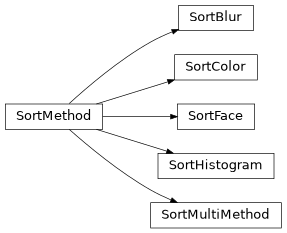
All sorting methods inherit from SortMethod and control functions for sorting one item,
sorting a full list of scores and binning based on those sorted scores.
- class tools.sort.sort_methods.SortBlur(arguments: Namespace, is_group: bool = False)
Sort images by blur or blur-fft amount
- Parameters:
arguments (Namespace) – The command line arguments passed to the sort process
is_group (bool) – Set to
Trueif this class is going to be called exclusively for binning. Default:False
- binning() list[list[str]]
Create bins to split linearly from the lowest to the highest sample value
- Return type:
List of bins of filenames
- estimate_blur(image: ndarray, alignments=None) float
Estimate the amount of blur an image has with the variance of the Laplacian. Normalize by pixel number to offset the effect of image size on pixel gradients & variance.
- Parameters:
image (ndarray) – The face image to calculate blur for
alignments – The metadata for the face image or
Noneif no metadata is available. If metadata is provided the face will be masked by the “components” mask prior to calculating blur. Default:None
- Return type:
The estimated blur score for the face
- estimate_blur_fft(image: np.ndarray, alignments: PNGAlignments | None = None) float
Estimate the amount of blur a fft filtered image has.
- Parameters:
image (np.ndarray) – Use Fourier Transform to analyze the frequency characteristics of the masked face using 2D Discrete Fourier Transform (DFT) filter to find the frequency domain. A mean value is assigned to the magnitude spectrum and returns a blur score. Adapted from https://www.pyimagesearch.com/2020/06/15/ opencv-fast-fourier-transform-fft-for-blur-detection-in-images-and-video-streams/
alignments (PNGAlignments | None) – The metadata for the face image or
Noneif no metadata is available. If metadata is provided the face will be masked by the “components” mask prior to calculating blur. Default:None
- Return type:
The estimated fft blur score for the face
- score_image(filename: str, image: np.ndarray | None, alignments: PNGAlignments | None) None
Score a single image for blur or blur-fft and add the result to
_result- Parameters:
filename (str) – The filename of the currently processing image
image (np.ndarray | None) – A face image loaded from disk
alignments (PNGAlignments | None) – The alignments dictionary for the aligned face or
None
- Return type:
None
- sort() None
Sort by metric score. Order in reverse for distance sort.
- Return type:
None
- class tools.sort.sort_methods.SortColor(arguments: Namespace, is_group: bool = False)
Score by channel average intensity or black pixels.
- Parameters:
arguments (Namespace) – The command line arguments passed to the sort process
is_group (bool) – Set to
Trueif this class is going to be called exclusively for binning. Default:False
- binning() list[list[str]]
Group into bins by percentage of black pixels
- Return type:
list[list[str]]
- score_image(filename: str, image: np.ndarray | None, alignments: PNGAlignments | None) None
Score a single image for color
- Parameters:
filename (str) – The filename of the currently processing image
image (np.ndarray | None) – A face image loaded from disk
alignments (PNGAlignments | None) – The alignments dictionary for the aligned face or
None
- Return type:
None
- sort() None
Sort by metric score. Order in reverse for distance sort.
- Return type:
None
- class tools.sort.sort_methods.SortFace(arguments: Namespace, is_group: bool = False)
Sort by identity similarity using an Identity plugin
- Parameters:
arguments (Namespace) – The command line arguments passed to the sort process
is_group (bool) – Set to
Trueif this class is going to be called exclusively for binning. Default:False
- binning() list[list[str]]
Group into bins by their sorted score
The bin ID has been output in the 2nd column of
_resultso use that for binning- Return type:
List of bins of filenames
- score_image(filename: str, image: np.ndarray | None, alignments: PNGAlignments | None) None
Score a single image for sort method and add the result to
_result. Attempts to pull identity information from the PNG metadata. If not available, pulls the information from the Identity plugin and stores in the PNG header for future use- Parameters:
filename (str) – The filename of the currently processing image
image (np.ndarray | None) – A face image loaded from disk or
Nonealignments (PNGAlignments | None) – The alignments dictionary for the aligned face or
None
- Return type:
None
- sort() None
Sort by dendrogram.
- Parameters:
matched_list – The list of tuples with filename in first position and face encoding in the 2nd
- Return type:
The original list, sorted for this metric
- class tools.sort.sort_methods.SortHistogram(arguments: Namespace, is_group: bool = False)
Sort by image histogram similarity or dissimilarity
- Parameters:
arguments (Namespace) – The command line arguments passed to the sort process
is_group (bool) – Set to
Trueif this class is going to be called exclusively for binning. Default:False
- binning() list[list[str]]
Group into bins by histogram
- Return type:
list[list[str]]
- score_image(filename: str, image: np.ndarray | None, alignments: PNGAlignments | None) None
Collect the histogram for the given face
- Parameters:
filename (str) – The filename of the currently processing image
image (np.ndarray | None) – A face image loaded from disk
alignments (PNGAlignments | None) – The alignments dictionary for the aligned face or
None
- Return type:
None
- sort() None
Sort by histogram.
- Return type:
None
- class tools.sort.sort_methods.SortMethod(arguments: Namespace, loader_type: T.Literal['face', 'meta', 'all'] = 'meta', is_group: bool = False)
Parent class for sort methods. All sort methods should inherit from this class
- Parameters:
arguments (Namespace) – The command line arguments passed to the sort process
loader_type (T.Literal['face', 'meta', 'all']) – The type of image loader to use. “face” just loads the image with the filename, “meta” just loads the image alignment data with the filename. “all” loads the image and the alignment data with the filename
is_group (bool) – Set to
Trueif this class is going to be called exclusively for binning. Default:False
- property bin_names: list[str]
The name of each created bin, if they exist, otherwise an empty list
- property binned: list[list[str]]
List of bins (list) containing the filenames belonging to the bin. The binning process is called when this property is first accessed
- binning() list[list[str]]
Group into bins by their sorted score. Override for method specific binning techniques.
Binning takes the results from
_resultcompiled during_sort_filelist()and organizes into bins for output.- Returns:
List of bins of filenames
- Return type:
list
- property loader_type: Literal['face', 'meta', 'all']
The loader that this sorter uses
- Type:
[“face”, “meta”, “all”]
- score_image(filename: str, image: np.ndarray | None, alignments: PNGAlignments | None) None
Override for sort method’s specific logic. This method should be executed to get a single score from a single image and add the result to
_result- Parameters:
filename (str) – The filename of the currently processing image
image (np.ndarray | None) – A face image loaded from disk or
Nonealignments (PNGAlignments | None) – The alignments dictionary for the aligned face or
None
- Return type:
None
- sort() None
Override for method specific logic for sorting the loaded statistics.
The scored list
_resultshould be sorted in place- Return type:
None
- property sorted_filelist: list[str]
List of sorted filenames for given sorter in a single list. The sort process is called when this property is first accessed
- class tools.sort.sort_methods.SortMultiMethod(arguments: Namespace, sort_method: SortMethod, group_method: SortMethod)
A Parent sort method that runs 2 different underlying methods (one for sorting one for binning) in instances where grouping has been requested, but the sort method is different from the group method
- Parameters:
arguments (Namespace) – The command line arguments passed to the sort process
sort_method (SortMethod) – A sort method object for sorting the images
group_method (SortMethod) – A sort method object used for sorting and binning the images
- binning() list[list[str]]
Override standard binning, to bin by the group-by method and sort by the sorting method.
Go through the grouped binned results, and reorder each bin contents based on the sorted list
- Return type:
List of bins of filenames
- score_image(filename: str, image: np.ndarray | None, alignments: PNGAlignments | None) None
Score a single image for sort method and add the result to
_result- Parameters:
filename (str) – The filename of the currently processing image
image (np.ndarray | None) – A face image loaded from disk or
Nonealignments (PNGAlignments | None) – The alignments dictionary for the aligned face or
None
- Return type:
None
- sort() None
Sort the sorter and grouper methods
- Return type:
None
Classes
|
Sort images by blur or blur-fft amount |
|
Score by channel average intensity or black pixels. |
|
Sort by identity similarity using an Identity plugin |
|
Sort by image histogram similarity or dissimilarity |
|
Parent class for sort methods. |
|
A Parent sort method that runs 2 different underlying methods (one for sorting one for binning) in instances where grouping has been requested, but the sort method is different from the group method |
Class Inheritance Diagram
tools.sort.sort_methods_aligned Module
Sorting methods that use the properties of a lib.align.AlignedFace object to obtain
their sorting metrics.
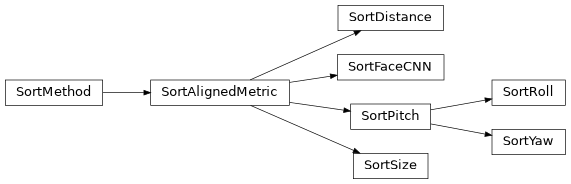
- class tools.sort.sort_methods_aligned.SortAlignedMetric(arguments: Namespace, loader_type: T.Literal['face', 'meta', 'all'] = 'meta', is_group: bool = False)
Sort by comparison of metrics stored in an Aligned Face objects. This is a parent class for sort by aligned metrics methods. Individual methods should inherit from this class
- Parameters:
arguments (
argparse.Namespace) – The command line arguments passed to the sort processsort_reverse (bool, optional) –
Trueif the sorted results should be in reverse order. Default:Trueis_group (bool, optional) – Set to
Trueif this class is going to be called exclusively for binning. Default:Falseloader_type (T.Literal['face', 'meta', 'all'])
- score_image(filename: str, image: np.ndarray | None, alignments: PNGAlignments | None) None
Score a single image for sort method: “distance”, “yaw”, “pitch” or “size” and add the result to
_result- Parameters:
filename (str) – The filename of the currently processing image
image (
np.ndarrayorNone) – A face image loaded from disk orNonealignments (dict or
None) – The alignments dictionary for the aligned face orNone
- Return type:
None
- sort() None
Sort by metric score. Order in reverse for distance sort.
- Return type:
None
- class tools.sort.sort_methods_aligned.SortDistance(arguments: Namespace, loader_type: T.Literal['face', 'meta', 'all'] = 'meta', is_group: bool = False)
Sorting mechanism for sorting faces from small to large
- Parameters:
arguments (Namespace)
loader_type (T.Literal['face', 'meta', 'all'])
is_group (bool)
- binning() list[list[str]]
Create bins to split linearly from the lowest to the highest sample value
- Returns:
List of bins of filenames
- Return type:
list
- sort() None
Override default sort to sort in ascending order.
- Return type:
None
- class tools.sort.sort_methods_aligned.SortFaceCNN(arguments: Namespace, is_group: bool = False)
Sort by landmark similarity or dissimilarity
- Parameters:
arguments (
argparse.Namespace) – The command line arguments passed to the sort processis_group (bool, optional) – Set to
Trueif this class is going to be called exclusively for binning. Default:False
- binning() list[list[str]]
Group into bins by CNN face similarity
- Returns:
List of bins of filenames
- Return type:
list
- sort() None
Sort by landmarks.
- Return type:
None
- class tools.sort.sort_methods_aligned.SortPitch(arguments: Namespace, loader_type: T.Literal['face', 'meta', 'all'] = 'meta', is_group: bool = False)
Sorting mechanism for sorting a face by pitch (down to up)
- Parameters:
arguments (Namespace)
loader_type (T.Literal['face', 'meta', 'all'])
is_group (bool)
- binning() list[list[str]]
Create bins from 0 degrees to 180 degrees based on number of bins
Allocate item to bin when it is in range of one of the pre-allocated bins
- Returns:
List of bins of filenames
- Return type:
list
- class tools.sort.sort_methods_aligned.SortRoll(arguments: Namespace, loader_type: T.Literal['face', 'meta', 'all'] = 'meta', is_group: bool = False)
Sorting mechanism for sorting a face by roll (rotation). Same logic as sort pitch, but with different metric
- Parameters:
arguments (Namespace)
loader_type (T.Literal['face', 'meta', 'all'])
is_group (bool)
- class tools.sort.sort_methods_aligned.SortSize(arguments: Namespace, loader_type: T.Literal['face', 'meta', 'all'] = 'meta', is_group: bool = False)
Sorting mechanism for sorting faces from small to large
- Parameters:
arguments (Namespace)
loader_type (T.Literal['face', 'meta', 'all'])
is_group (bool)
- binning() list[list[str]]
Create bins to split linearly from the lowest to the highest sample value
Allocate item to bin when it is in range of one of the pre-allocated bins
- Returns:
List of bins of filenames
- Return type:
list
- class tools.sort.sort_methods_aligned.SortYaw(arguments: Namespace, loader_type: T.Literal['face', 'meta', 'all'] = 'meta', is_group: bool = False)
Sorting mechanism for sorting a face by yaw (left to right). Same logic as sort pitch, but with different metric
- Parameters:
arguments (Namespace)
loader_type (T.Literal['face', 'meta', 'all'])
is_group (bool)
Classes
|
Sort by comparison of metrics stored in an Aligned Face objects. |
|
Sorting mechanism for sorting faces from small to large |
|
Sort by landmark similarity or dissimilarity |
|
Sorting mechanism for sorting a face by pitch (down to up) |
|
Sorting mechanism for sorting a face by roll (rotation). |
|
Sorting mechanism for sorting faces from small to large |
|
Sorting mechanism for sorting a face by yaw (left to right). |
Class Inheritance Diagram