lib.config package
Holds, validates and handles faceswap configuration items, ensuring type correctness. Handles interfacing with saved config .ini files
lib.config.config Module
Default configurations for faceswap. Handles parsing and validating of Faceswap Configs and
interfacing with configparser.ConfigParser
- class lib.config.config.FaceswapConfig(config_file: str | None = None)
Config Items
- Parameters:
config_file (str | None)
- add_item(section: str, title: str, config_item: ConfigItem) None
Add a default item to a config section
- Parameters:
section (str) – The section of the config to add the item to
title (str) – The name of the config item
config_item (
ConfigItem) – The default config item object to add to the config
- Return type:
None
- add_section(title: str, info: str) None
Add a default section to config file
- Parameters:
title (str) – The title for the section
info (str) – The helptext for the section
- Return type:
None
- save_config() None
Update the ini file with the currently stored app values and save the config file.
- Return type:
None
- sections: dict[str, ConfigSection]
The Faceswap config sections and options
- Type:
dict[str,
ConfigSection]
- set_defaults(helptext: str = '') None
Override for plugin specific config defaults.
This method should always be overridden to add the help text for the global plugin group. If helptext is not provided, then it is assumed that there is no global section for this plugin group.
The default action will parse the child class’ module for
ConfigItemobjects and add them to this plugin group’s “global” section ofsections.The name of each config option will be the variable name found in the module.
It will then parse the child class’ module for subclasses of
GlobalSectionobjects and add each of these sections to this plugin group’ssections, adding anyConfigItemwithin the GlobalSection to that sub-section.The section name will be the name of the GlobalSection subclass, lowercased
- Parameters:
helptext (str) – The help text to display for the plugin group
- Raises:
ValueError – If the plugin group’s help text has not been provided
- Return type:
None
- lib.config.config.generate_configs(force: bool = False) None
Generate config files if they don’t exist.
This script is run prior to anything being set up, so don’t use logging Generates the default config files for plugins in the faceswap config folder
- Logic:
Scan the plugins path for files named <parent_folder>_config.py>
Import the discovered module and look for instances of FaceswapConfig
If exists initialize the class
- Parameters:
force (bool) – Force the loading of all plugin configs even if their .ini files pre-exist
- Return type:
None
- lib.config.config.get_configs() dict[str, FaceswapConfig]
Get all of the FaceswapConfig options. Loads any configs that have not been loaded and return a dictionary of all configs.
- Returns:
All of the loaded faceswap config objects
- Return type:
dict[str,
FaceswapConfig]
Functions
|
Generate config files if they don't exist. |
Get all of the FaceswapConfig options. |
Classes
|
Config Items |
lib.config.ini Module
Handles interfacing between Faceswap Configs and ConfigParser .ini files
- class lib.config.ini.ConfigFile(plugin_group: str, ini_path: str | None = None)
Handles the interfacing between saved faceswap .ini configs and internal Config objects
- Parameters:
plugin_group (str) – The plugin group that is requesting a config file
ini_path (str | None) – Optional path to a .ini config file.
Nonefor default location. Default:None
- format_help(helptext: str, is_section: bool = False) str
Format comments for insertion into a config ini file
- Parameters:
helptext (str) – The help text to be formatted
is_section (bool) –
Trueif the help text pertains to a section.Falseif it pertains to an option. Default:True
- Return type:
The formatted help text
- load() None
Load values from the saved config ini file into our Config object
- Return type:
None
- on_load(app_config: dict[str, ConfigSection]) None
Check whether there has been any change between the current application config and the loaded ini config. If so, update the relevant object(s) appropriately. This check will also create new config.ini files if they do not pre-exist
- Parameters:
app_config (dict[str, ConfigSection]) – The latest configuration settings from the application. Section name is key
- Return type:
None
- save() None
Save a config file
- Return type:
None
- update_from_app(app_config: dict[str, ConfigSection]) None
Update the config.ini file to those values that are currently in Faceswap’s app config
- Parameters:
app_config (dict[str, ConfigSection]) – The latest configuration settings from the application. Section name is key
- Return type:
None
Classes
|
Handles the interfacing between saved faceswap .ini configs and internal Config objects |
lib.config.objects Module
Dataclass objects for holding and validating Faceswap Config item
- class lib.config.objects.ConfigItem(datatype: type[~lib.config.objects.T], default: ~lib.config.objects.T, group: str, info: str, choices: list[str] | ~typing.Literal['colorchooser'] = <factory>, gui_radio: bool = False, min_max: tuple[~lib.config.objects.T, ~lib.config.objects.T] | None = None, rounding: int = -1, fixed: bool = True)
A dataclass for storing config items loaded from config.ini files and dynamically assigning and validating that the correct datatype is used.
The value loaded from the .ini config file can be accessed with either:
>>> conf.value
>>> conf()
>>> conf.get()
- Parameters:
datatype (type[lib.config.objects.T]) – A python type class. This limits the type of data that can be provided in the .ini file and ensures that the value is returned to faceswap is correct. Valid datatypes are: int, float, str, bool or list. Note that list items must all be strings.
default (lib.config.objects.T) – The default value for this option. It must be of the same type as
datatype.group (str) – The group that this config item exists within in the config section
info (str) – A description of what this option does.
choices (list[str] | Literal['colorchooser']) – If this option’s datatype is a str then valid selections can be defined here, empty list for any value. If the option’s datatype is a list, then this option must be populated with the valid selections. This validates the option and also enables a combobox / radio option in the GUI. If the default value is a hex color value, then this should be the literal “colorchooser” to present a color choosing interface in the GUI. Ignored for all other datatypes Default: [] (empty list: no options)
gui_radio (bool) – If
choicesare defined, this indicates that the GUI should use radio buttons rather than a combobox to display this option. Default:Falsemin_max (tuple[lib.config.objects.T, lib.config.objects.T] | None) – For int and float
datatypethis is required otherwise it is ignored. Should be a tuple of min and max accepted values of the same datatype as the option value. This is used for controlling the GUI slider range. Values are not enforced. Default:Nonerounding (int) – For int and float :attr:datatypes this is required to be > 0 otherwise it is ignored. Used for the GUI slider. For `float, this is the number of decimal places to display. For int this is the step size. Default: -1 (ignored)
fixed (bool) – [train only]. Training configurations are fixed when the model is created, and then reloaded from the state file. Marking an item as fixed=``False`` indicates that this value can be changed for existing models, and will override the value saved in the state file with the updated value in config. Default:
True
- __call__() T
Obtain the currently stored configuration value
- Returns:
The config value for this item loaded from the config .ini file. String values will always
be lowercase, regardless of what is loaded from Config
- Return type:
- choices: list[str] | Literal['colorchooser'] = <dataclasses._MISSING_TYPE object>
If this option’s datatype is a str then valid selections may be defined here, Empty list if any value is valid. If the datatype is a list then valid choices will be populated here. If the default value is a hex color code, then the literal “colorchooser” will display a color choosing interface in the GUI.
- datatype: type[T] = <dataclasses._MISSING_TYPE object>
A python type class. The datatype of the config value. One of int, float, str, bool or list. list will only contain str items
- default: T = <dataclasses._MISSING_TYPE object>
The default value for this option. It is of the same type as
datatype
- fixed: bool = True
Only used for train.model configurations. Options marked as fixed=``False`` indicates that this value can be changed for existing models, otherwise the option set when the model commenced training is fixed and cannot be changed. Default:
True
- get() T
Obtain the currently stored configuration value
- Returns:
The config value for this item loaded from the config .ini file. String values will always
be lowercase, regardless of what is loaded from Config
- Return type:
- group: str = <dataclasses._MISSING_TYPE object>
The group that this config option belongs to
- gui_radio: bool = False
indicates that the GUI should use radio buttons rather than a combobox to display this option if
choicesis populated
- property helptext: str
Description of the config option with additional formatting and helptext added from the item parameters
- info: str = <dataclasses._MISSING_TYPE object>
A description of what this option does
- property ini_value: str
The current value of the ConfigItem as a string for writing to a .ini file
- min_max: tuple[T, T] | None = None
For int and float
datatypethis will be populated otherwise it will beNone. Used for controlling the GUI slider range. Values are not enforced.
- property name: str
The name associated with this option
- rounding: int = -1
For int and float
datatypesthis will be > 0 otherwise it will be -1. Used for the GUI slider. For float, this is the number of decimal places to display. For int this is the step size.
- set_name(name: str) None
Set the logging name for this object for display purposes
- Parameters:
name (str) – The name to assign to this option
- Return type:
None
- class lib.config.objects.ConfigSection(helptext: str, options: dict[str, ConfigItem])
Dataclass for holding information about configuration sections and the contained configuration items
- Parameters:
helptext (str) – The helptext to be displayed for the configuration section
options (dict[str, lib.config.objects.ConfigItem]) – Dictionary of configuration option name to the options for the section
- class lib.config.objects.GlobalSection(helptext: str)
A dataclass for holding and identifying global sub-sections for plugin groups. Any global subsections must inherit from this.
- Parameters:
helptext (str) – The helptext to be displayed for the global configuration section
Classes
|
A dataclass for storing config items loaded from config.ini files and dynamically assigning and validating that the correct datatype is used. |
|
Dataclass for holding information about configuration sections and the contained configuration items |
|
A dataclass for holding and identifying global sub-sections for plugin groups. |
Variables
Type variable. |
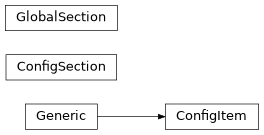
Class Inheritance Diagram