lib.multithreading Module
Multithreading/processing utils for faceswap
- class lib.multithreading.BackgroundGenerator(generator: Callable, prefetch: int = 1, name: str | None = None, args: tuple | None = None, kwargs: dict[str, T.Any] | None = None)
Run a task in the background background and queue data for consumption
- Parameters:
generator (Callable) – The generator to run in the background
prefetch (int) – The number of items to pre-fetch from the generator before blocking (see Notes). Default: 1
name (str | None) – The thread name. if
Nonea unique name is constructed of the form {generator.__name__}_N where N is an incrementing integer. Default:Noneargs (tuple | None) – The argument tuple for generator invocation. Default:
None.kwargs (dict[str, T.Any] | None) – keyword arguments for the generator invocation. Default:
None.
Notes
Putting to the internal queue only blocks if put is called while queue has already reached max size. Therefore this means prefetch is actually 1 more than the parameter supplied (N in the queue, one waiting for insertion)
References
https://stackoverflow.com/questions/7323664/
- iterator() Generator
Iterate items out of the queue
- Yields:
The items from the generator
- Return type:
Generator
- class lib.multithreading.ErrorState
An object for tracking error state across threads
The “set” method should be called from within a thread to set the thread error traceback
The “check_and_raise” method should be called from the main thread to check for and re-raise any errors
- clear() None
Clear any stored errors
- Return type:
None
- errors: list[tuple[type[BaseException], BaseException, TracebackType] | tuple[Any, Any, Any]]
list of errors that have been detected within threads
- property has_error: bool
Check whether any running FSThread thread has an error.
- Return type:
Trueif an FSThread has an error
- re_raise() None
Check if a thread error is stored and re-raise it if so. Should be called from main thread. Only the first error received is re-raised (in the event of multiple errors)
- Return type:
None
- set(exc_info: tuple[type[BaseException], BaseException, TracebackType] | tuple[Any, Any, Any]) None
Set the error traceback information to the error state object. Errors are appended to the error list in the order that they are received
- Parameters:
set (The traceback error information to)
exc_info (tuple[type[BaseException], BaseException, TracebackType] | tuple[Any, Any, Any])
- Return type:
None
- class lib.multithreading.FSThread(target: Callable | None = None, name: str | None = None, args: tuple = (), kwargs: dict[str, T.Any] | None = None, *, daemon: bool | None = None)
Subclass of thread that passes errors back to parent
- Parameters:
target (Callable | None) – The callable object to be invoked by the run() method. If
Nonenothing is called. Default:Nonename (str | None) – The thread name. if
Nonea unique name is constructed of the form “Thread-N” where N is a small decimal number. Default:Noneargs (tuple) – The argument tuple for the target invocation. Default: ().
kwargs (dict[str, T.Any] | None) – keyword arguments for the target invocation. Default: {}.
daemon (bool | None)
- check_and_raise_error() None
Checks for errors in thread and raises them in caller.
- Raises:
Error – Re-raised error from within the thread
- Return type:
None
- error_state = <lib.multithreading.ErrorState object>
Class attribute to track error state across multiple threads
- run() None
Runs the target, and captures any thread errors for re-raising in the caller.
Errors are also captured in a class attribute so that threads in any other running FSThreads can be captured
- Return type:
None
- class lib.multithreading.MultiThread(target: Callable, *args, thread_count: int = 1, name: str | None = None, **kwargs)
Threading for IO heavy ops. Catches errors in thread and rethrows to parent.
- Parameters:
target (Callable) – The callable object to be invoked by the run() method.
args – The argument tuple for the target invocation. Default: ().
thread_count (int) – The number of threads to use. Default: 1
name (str | None) – The thread name. if
Nonea unique name is constructed of the form {target.__name__}_N where N is an incrementing integer. Default:Nonekwargs – keyword arguments for the target invocation. Default: {}.
- check_and_raise_error() None
Checks for errors in thread and raises them in caller.
- Raises:
Error – Re-raised error from within the thread
- Return type:
None
- completed() bool
Check if all threads have completed
- Return type:
Trueif all threads have completed otherwiseFalse
- property errors: list[tuple[type[BaseException], BaseException, TracebackType] | tuple[Any, Any, Any]]
List of thread error values
- Type:
list
- property has_error: bool
Trueif a thread has errored, otherwiseFalse
- is_alive() bool
Check if any threads are still alive
- Return type:
Trueif any threads are alive.Falseif no threads are alive
- join() None
Join the running threads, catching and re-raising any errors
Clear the list of threads for class instance re-use
- Return type:
None
- property name: str
The name of the thread
- start() None
Start all the threads for the given method, args and kwargs
- Return type:
None
- lib.multithreading.total_cpus() int
Return total number of cpus
- Return type:
int
Functions
Return total number of cpus |
Classes
|
Run a task in the background background and queue data for consumption |
An object for tracking error state across threads |
|
|
Subclass of thread that passes errors back to parent |
|
Threading for IO heavy ops. |
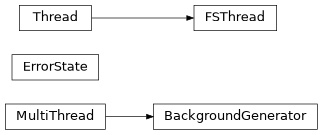
Class Inheritance Diagram